 Four Quadrants Advisory
Should you really hire a Dental Associate yet?
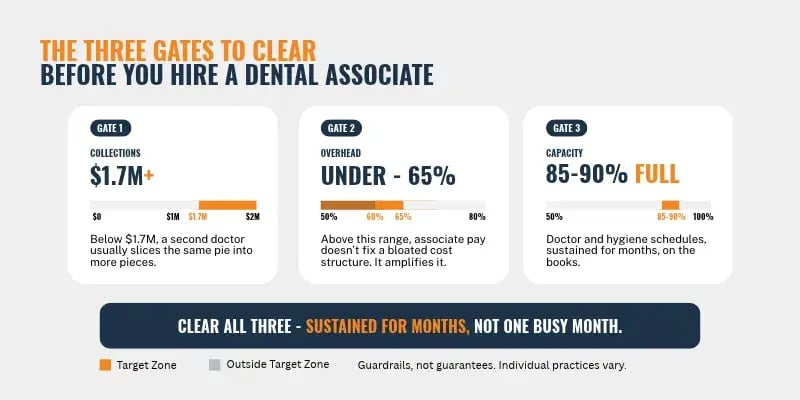
The best time to hire a dental associate is when your practice can already feed them profitably. That typically means $1.7+ million in collections, overhead under about 65%, and doctor and hygiene schedules running near capacity for months, not just when you're tired or want more time off.
For most owners, the urge starts as an itch. You're booked out. You're tired of being the only producer. Production stops every time you take a vacation. On paper, things look "good enough," and the story sounds simple: If I bring on an associate, I'll make more, work less, and someone will eventually buy me out.
Nationwide, we see almost the opposite. Roughly 80% of associates never become partners. Instead of more profit, many owners quietly cannibalize their own income by adding another doctor to an already struggling model. They go from busy and stressed to less busy, more stressed, and making less.
The blunt truth: hiring an associate isn't a badge of honor. It's a high-risk, high-leverage business decision. If the numbers, insurance mix, and practice vision aren't ready, you're paying $1.10 to get a dollar back. You may feel busier and more important. Your bank account and retirement don't care about your ego.
A healthy decision starts with clarity: why you want an associate, whether your model can support one, and how the hire fits your long-term plan for ownership and retirement. Before you post a job ad or grab coffee with that promising young dentist, put on your CEO hat. The clinician in you can like them. The owner in you has to know the math works.
This guide covers the benchmarks, four non-negotiable questions, and the landmines we see when owners hire on emotion instead of data.
The Numbers Test: Collections, Overhead, and Capacity
Financially, most owners shouldn't hire a dental associate until:
- Collections are at least $1.7 million
- Owner income is $500K+
- Overhead is at or below roughly 65%
- Doctor and hygiene schedules run 85–90% full for several months straight for hygiene and 6+ weeks for the dentist
Not magic numbers. Reliable guardrails.
Collections: Why $1.7+ Million Matters
Working exclusively with dental practice owners, we see the same pattern: the practices that can truly afford an associate collect $1.7 million or more. Some exceptions exist, such as an exceptionally efficient producer or a strong fee-for-service model. But for most owners under about $1.7 million, a second doctor slices the same pie into more pieces. You feel busier. Your income goes the wrong direction.
Overhead: The Second Gate
Industry benchmarking commonly targets overhead under about 60% of collections, with 60–65% typical for many private practices. Already above that range? Be very cautious about layering on associate pay, extra staff, more supplies, and lab bills. You don't fix a bloated cost structure by adding a producer. You amplify it.
Capacity: Don't Fool Yourself
This is where many owners fool themselves. One busy month isn't demand for another doctor. Look for sustained 85–90% utilization in both hygiene and doctor columns over several months; not a seasonal spike. You also need a meaningful amount of diagnosed but unscheduled treatment on the books.
Payer Mix: The Hidden Profit Killer
Then look at payer mix. We routinely see two-doctor practices drowning in PPO write-offs. On paper, they're busy: multiple providers, packed schedules, lots of plans. In reality, partners and associates would produce a lot but collect much less. You pay on collections, so you would need to get more efficient by streamlining insurance first.
Your Associate Readiness Checklist
Crossing a million in collections or feeling slammed clinically doesn't make you ready. Run an honest numbers test:
- Collections over $1.7 million, with a realistic path to $2 million+
- Overhead under about 65%; trending down, not up
- Doctor and hygiene at 85–90% capacity for months
- A growing pool of diagnosed treatment
- A strategy for your worst-paying insurance plans, not just hope
Check those boxes, and you may be ready. Nowhere close? Your next move isn't an associate. It's fixing the business you already own.
Four Tough Questions to Answer Before You Hire a Dental Associate
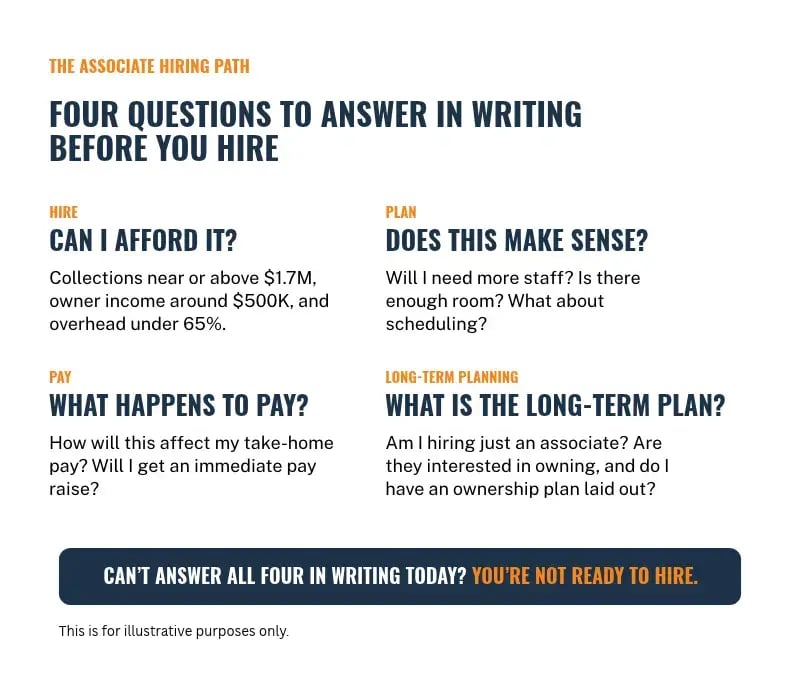
Before you hire, answer these four questions in writing:
- Can I afford it?
- How do I envision this person coming into the practice? (Logistics: more staff, enough room, scheduling, etc.)
- What happens to pay once you bring in an associate?
- What is the long-term plan? Just an associate? Is there an ownership path? Not sure?
Can't answer them today? You're not ready to hire.
Can I Afford It?
It sounds simple, and it gets ignored the most. Affording an associate means more than covering their guaranteed pay. The practice has to pay them well, keep you whole or better, and still hit your retirement targets.
For many of our clients, that looks like collections near or above $1.7 million, owner income around $500,000, and overhead under 65%. At $1.2 million in collections, barely paying yourself what you want now, an associate won't magically fix it. We often see owners bring someone in at that level, watch their income fall, and unwind the whole thing two or three years later; wasted time for both doctors.
How do I envision this person coming into the practice?
Bringing on an associate is one thing. Having a logistical plan in place is another.
-
Do you have enough staff to handle another dentist?
-
Is there enough room?
-
How will the schedule be handled?
Even if you can afford an associate, does it make sense logistically? If you don't know the answers, it's time to pump the brakes and focus on developing a plan.
What Happens to Pay?
Do you get an immediate pay raise after bringing in an associate? Think again. Expect an initial step back, but a good strategy and implementation plan will lead to a raise down the road. Funneling as much as you can to the associate lets you focus on bigger procedures they may not be comfortable with, or that are not time-efficient. This allows the raise to come sooner.
What is the long-term plan?
- Just an associate?
- Ambitions to own one day? If so, what is the ownership path plan?
The two paths are very different, and so should the pay structure. Straight production and collection never create economies of scale and increase the chance the associate earns so much they don't want the hassle of ownership.
"I'll just slow down at some point" isn't a plan. That exact ambiguity has sent more than a few owner–associate pairs into court.
Why Personality Fit Isn't Enough
The pattern repeats: the owner finds someone they like, the personalities fit, the team's excited, and everyone assumes the hard questions will "work themselves out." Personality fit is the icing. These four questions are the batter. Skip them, and you don't have a cake; you have a mess with frosting on top.
Ready to Run the Numbers on Your Practice?
Weighing an associate hire? Start with a clear look at your own collections, overhead, and capacity. Book your discovery call with one of our dental-specific advisors to find out whether your numbers support the hire and what to fix first if they don't.
Frequently Asked Questions
When should a dental practice hire an associate? Most practices are ready when collections reach $1.7+ million, overhead sits under about 65%, and both doctor and hygiene schedules have run 85–90% full for several months for hygienists and 6+ weeks for the doctor — with diagnosed treatment still on the books.
What overhead percentage is healthy before hiring a dental associate? Benchmarks commonly target overhead under about 60% of collections, with 60–65% typical for many private practices. Above that, adding associate pay, staff, supplies, and lab costs tends to amplify the problem rather than fix it.
Can a practice collecting under $1.7 million afford an associate? Rarely. Below roughly $1.7 million in collections, a second doctor usually splits the same production into more pieces, and owner income often falls. An unusually efficient producer or a strong fee-for-service model can be an exception.
Do most dental associates become partners? No. In our experience, roughly 80% of associates never become partners — which is why a good strategy matters before the hire, not after.